Customer story
The problem
At seed stage, every marketing decision competes with product development, sales calls, customer work, and fundraising. For a three-person team, marketing was not simply under-resourced. It was largely unstaffed.
The founders had deep knowledge of the product and the market, but no system for turning that knowledge into demand. The company had: No clear positioning or category narrative No meaningful visibility for competitive search terms No consistent thought-leadership engine No repeatable LinkedIn or video cadence No structured process for identifying and reaching target accounts Every channel started from zero. A blog post required fresh research.
A LinkedIn post needed a new angle. Outbound lists were built separately from the company’s positioning and content. Nothing carried context from one activity into the next.
The obvious answer was to hire. But the company did not need one generalist. It needed several disciplines at once: product marketing to sharpen the story, SEO expertise to build visibility, a content strategist to shape the narrative, and an operator to keep publishing and distribution moving.
Building that the traditional way meant assembling a team the company couldn’t justify at seed stage. And the business did not need another collection of tools, either. A broad tech stack would still leave the founders responsible for deciding what to do and connecting the pieces.
Ultimately, the company needed a marketing function before it was ready to build a marketing team.
“You spend a year building something you know is good, and then it hits you that the market has no idea you exist. We’re three people. Hiring a marketing team was never on the table, and none of us had the time to go become the marketer.”
Before / After
The company had strong founder knowledge but no clear system for taking it to market. Its positioning was still taking shape. Search visibility was close to zero.
Content and LinkedIn activity happened when someone found the time. Outbound was disconnected from the brand story, and there was no repeatable way to turn one good idea into work across several channels. After using Gyrify, the company had: A brand foundation — positioning, messaging, and ICP — built before any content, so everything downstream stayed consistent.
Search and answer-engine work made accessible to a non-specialist, and turned into recommendations the team could act on. A strategy-first content engine, in place of having no content at all. Targeted lead lists and outbound built from the same brand and ICP knowledge.
One operator running the whole function, instead of the five roles the company couldn’t hire.
Workstreams
Rather than treating SEO, content, social, and outbound as separate projects, Gyrify built them as parts of the same marketing system.
Brand Messaging
Gyrify built the company’s positioning, messaging, brand voice, and ICP from scratch, so every output that followed started from one shared foundation.
FoundationSEO and Category Visibility
Gyrify audited a near-empty search presence, found the targeted opportunities that mattered, and turned them into recommendations the company could act on without being an SEO or AEO specialist.
SearchThought Leadership & Content
Working from the company’s strategy and point of view, Gyrify produced the ideas, briefs, and drafts behind a consistent content program that built the company’s authority in its category — including the thought-leadership pieces a three-person team could never have produced on its own.
ContentSocial Media
Gyrify planned and drafted the company’s LinkedIn presence in the founder’s voice, building authority on the channel where its buyers actually pay attention. And it became one of the top inbound channels for the company.
DistributionICP research and Outbound
Gyrify translated the company’s ICP into clear account and contact criteria, then used that context to build highly targeted lead lists. Outbound messaging drew from the same positioning, buyer problems, and market knowledge used across the rest of the marketing system.
PipelineVideos
Gyrify wrote the scripts behind the company’s video, extending the same brand narrative into a format the team wouldn’t have had the bandwidth to plan.
VideoSolution
The work began with the layer most AI content tools skip: deciding what the company should be known for. Using Gyrify, the operator worked with the founding team to sharpen the commercial direction, pressure-test the positioning, and identify the ideas the company had a credible right to own. Gyrify then turned that direction into a working strategy. It mapped the audience, category themes, buyer questions, search opportunities, content priorities, and distribution channels.
“The breakthrough was choosing what we would not talk about. Once Tenet helped us narrow the category themes we could genuinely own, the company became much easier to explain.”
Once the foundation was clear, the AI agent carried the strategy through each part of the marketing operation. Search insights shaped the editorial calendar. Long-form content became LinkedIn posts and video scripts. The company’s ICP and positioning informed lead selection and outbound messaging. Performance data fed back into what Gyrify recommended next. Nothing was created as a standalone asset. Each piece strengthened the same market position.
Results
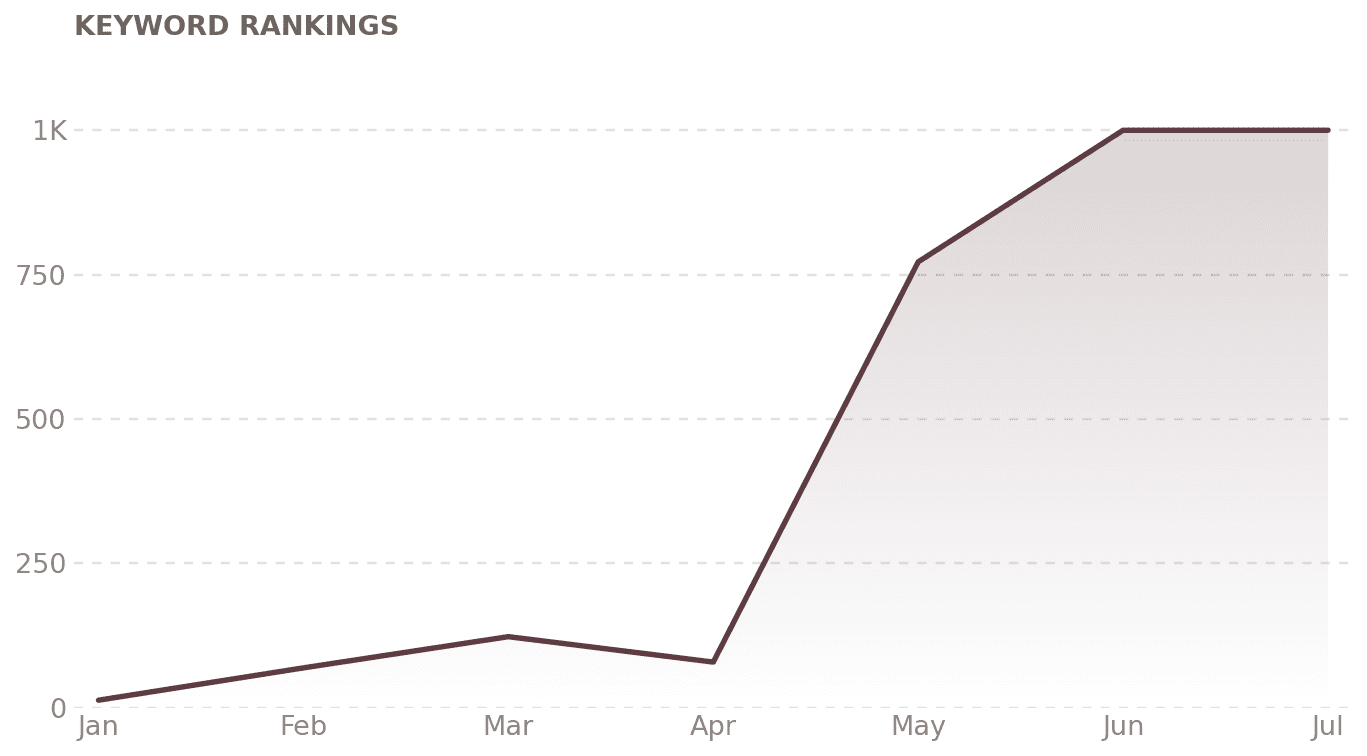
Search provided the clearest evidence that the system was beginning to compound. Before the content and SEO motion took hold, the company had almost no presence for competitive, non-branded queries. Search engines had very little information connecting the brand to the category it wanted to enter.
Within four months, the company had accumulated more than 2,500 targeted keyword rankings and crossed 1,000 distinct ranking queries. The visibility was not built on random, high-volume keywords. The strategy focused on terms connected to the company’s category, buyer problems, product, and commercial priorities.
As more connected content went live, the brand began appearing across the conversations it wanted to become associated with.
“As a seed-stage company, we could not outspend the incumbents. But we could out-focus them. Tenet gave us the discipline and execution capacity to build around a small number of ideas until the market started paying attention.”
The most important result was not one article, campaign, or ranking. It was the engine underneath them. In four months, a three-person company established the foundations of a marketing function: Brand positioning and messaging Search and content strategy Thought-leadership production LinkedIn distribution Video development ICP research and lead generation Brand-aligned outbound Performance measurement and iteration The founders still set the business direction.
A senior operator still applied judgment and oversight. But the company no longer depended on the founders to personally coordinate and produce every part of its marketing.
“The 2,500 high-intent rankings are evidence of something bigger. The market is beginning to associate our company with the category we set out to own. You cannot manufacture that.”
Takeaways
For a three-person team, the shift wasn’t only speed. It was going from no marketing function to a real one, without the hire or the agency that usually stands in the way.
A whole function, built from zero
Gyrify stood up the pieces a lean team rarely has time to build: positioning, a content engine, a search foundation, social, and outbound, all from one brand context.
Authority without a team or an agency
One operator ran a marketing motion far beyond a three-person headcount, with every channel drawing on the same strategy.
Targeted, so results compound
Because the keywords, content, lead lists, and outbound all came from the same ICP and brand, the work built on itself instead of pulling in different directions.
FROM THE READING LIST
Keep the ideas going
Loop Engineering Is Rewriting the Rules of AI Marketing
Explore whitepaper Research & technologyWhat is a content engineer? What they do, skills, tools, and why companies need them
Read article Research & technologyWhat is a GTM engineer? Responsibilities, skills, tools, and business impact
Read articleA little more capacity. A lot more possibility
Tell us what you want marketing to do next. We’ll show you how Gyrify can help.